Monday, October 21, 2024

 Rehoboam - A Man, A King

There is something about Rehoboam that intrigues me so I thought I would spend some time studying this man who is rarely talked about. 
His name means "an enlarged people'.  So often in the Bible names point to the name-bearer's character or something that defines his life. This is true for Rehoboam. It was under his reign that the nation of Israel split into two kingdoms  -  Israel and Judah. 

Rehoboam was Solomon's son. What a lineage he came from, King David was his grandfather. I'm sure King David died before Rehoboam was born, but I'm sure he heard many stories over and over again  about his famous grandfather. 
His mother was an Ammonite, a people who were not highly thought of by the Israelites. They had sided along with the Moabites to call for Balaam to curse Israel . So why would Solomon allow Rehoboam to marry an Ammonite?  It is thought that  Naamah was the daughter of Shobi, an Ammonite who brought generous supplies to David and the people with him in the desert because Shobi said, "the people are hungry and thirsty and weary in the desert." When you read the list of supplies he brought (II Sam. 17:27-29) we can surmise that he was very wealthy. It is always noteworthy and humbling when an enemy reaches out in kindness, so it is not unreasonable to conclude that David , as he rewarded others, wanted to do something to honor Sobi and so David arranged a marriage between his son Solomon, and Sobi's daughter. Naamah.  
She is the only wife of Solomon that we have a name for - all his other 1000 wives are simply said to have come from all the pagan nations -  maybe Naamah is named only because it was her son who inherited the throne from his father. Interestingly, she is mentioned twice in I Kings 14:21 and 31. 

Rehoboam's name does not go down in history as one of the best kings of Judah but he was not all 'bad',.  At the time that he ruled, Judah "did evil in the sight of the Lord", so he had to deal with a people who were in rebellion against God. 

One of the first things Rehoboam did after he became king is an interesting story.  

A man by the name of Jeroboam had gained favor in the eyes of Solomon who  made him the CEO over all the labour force.  Then one day, a prophet named Ahijah came to Jeroboam and prophesied that God was going to give him 10 tribes of Israel.  When this prophecy was told to Solomon, he became very angry. Not unlike the anger of King Herod when he heard another  king had been born.  It seems out of character for Solomon but maybe he did not believe this prophecy was of the Lord.  In any event, he sought to kill Jeroboam and to escape Jeroboam fled to Egypt and remained there until Solomon's death. 
When Jeroboam heard that Rehoboam was now King, he came to present him with a request and a promise. If Rehoboam would grant his request then Jeroboam and his people would pledge their allegiance to Rehoboam.  The request was that Rehoboam lightened the load of required service and taxes that Solomon had demanded from them. 
Rehoboam listened and to his credit sought advice before making his decision. 
He consulted the elders who had advised his father Solomon, but he also consulted his peers. 
The elders in their wisdom advised that if Rehoboam would treat the people kindly, they would serve him with loyalty and  gladness. 
Rehoboam's peers gave the opposite advice.  They advised him to make the load even heavier, to make the burdens on the people even heavier than Solomon had ever ordered. Solomon had inflicted pain with whips, but Rehoboam should chastise them with scourges. 

This is the part of the story I find intriguing.  Rehoboam rejected the advice of the elders and followed the advice of his peers - young men who had not yet lived long enough to gain any wisdom. Wrong choice, right? 
BUT ...look at what the verse says (II Chronicles 10:15) "So the king did not listen to the people, for the turn of affairs was from God that the Lord might fulfill His word which He had spoken by the hand of Ahijah."   
Remember it was Ahijah that had  prophesied that Jeroboam would rule over 10 tribes.  
After 3 days Jeroboam and his people came to hear what Rehoboam had decided and when they heard that Rehoboam was going to make things worse, not better, they rebelled and decided to leave saying, "We want nothing to do with you, Judah, we declare we have no inheritance with you!"   
Rehoboam tried to bring Jeroboam and the 10 tribes back into submission, to reunite them with Judah's two tribes,  but God sent word to Rehoboam through Shemaish, the man of God,  that he was not to fight against Jeroboam and his people because this division was of God. 
From that time on, Israel was two nations,  Jeroboam ruling over the 10 tribes that became known as Israel, as Ahijah had prophesied,  and Rehoboam ruled over the two tribes that became known as Judah. 

Rehoboam took the wrong advice, but it was 'of God' ??  It made me realize that even when we see people in leadership make horrible decisions, God is not out of control.  He has already planned how everything will work into His plan and purposes. 
We know by reading through the succession of kings over Israel and those over Judah  that  both Israel and Judah had wicked kings , Israel had almost NO good kings, we find by far most of the godly kings ruling over Judah. . Even  the Levites deserted their common lands and possessions and came to join Judah because Jeroboam and his sons had rejected them from serving as priests before the Lord. 

So we see that God's plan was to separate for Himself a 'remnant' of Israel that He could bring through to the coming of the Redeemer. 
God used Rehoboam,  even his sin and rebellion, to bring about His purposes. 

When Rehoboam had established his kingdom and rule, his success went to his head and  he forsook the law of God and took the people with him. 
It says in his epitaph ((II Chron. 12:14)  that "he did evil, because he did not prepare his heart to seek the Lord" 
Then the king of Egypt came up against Jerusalem - God removed His hand of protection-   because they had transgressed against the Lord.  
If we want to go our own way instead of following God's way, we bring upon ourselves the 'evil' that is the result and consequences of choosing contrary to God.  
But God is always gracious and desiring to draw the people back into His 'goodness'.  
So God did not forsake Rehoboam. He sent the prophet Shemaiah to Rehoboam and rebuked the king for having forsaken the Lord.
Rehoboam responded to the rebuke with humility and repentance, declaring that the Lord was righteous in all His doings.  God has never turned away a humble heart and here too, He forgave Rehoboam and said He would not allow the King of Egypt to destroy  Jerusalem and its people,  but He would allow Egypt to put them under tribute . They would have to serve Egypt. 

Why did God do that?  He gives us the answer.  He wanted to teach His people to know the difference between serving  God and serving an ungodly ruler/master. 
Often God will forgive and restore but will leave some of the consequences of our sin in place to teach us something we need to learn  or to help us remember to stay in obedience to God. 

The King of Egypt carried away all the treasures of the house of the Lord as well as the king's house - he took everything and we know that would have been an incredible loss.  Solomon's riches are legend.  The king also took the gold shields that Solomon had made.  Rehoboam replaced them, by making bronze shields (obviously didn't have enough to remake them in gold)  and committed them to the hands of the captains of the guard who guarded the entrance of the king's house.  So then whenever the king entered the house of the Lord , the guard would go and bring them out, then when Rehoboam finished his temple service, would  take them back again to the guardroom. 
Did Rehoboam end well?  We are told that when he humbled himself, the wrath of the Lord turned from him.  So my impressions is that like Solomon who turned back to God at the end of his life, so also  Rehoboam finally became humble and wise  
(note someone may wonder at the verse in II Chron. 12:14, We might take it to mean it is a statement about the end of his life -- but it isn't.  It is simply pointing out that he 'did evil' when he turned away from the Lord - it is a look back to before Egypt attacked Jerusalem. His story does not give any indication that his repentance and humility did not last to the end of his life.) 

We find it easy to make sweeping judgements against Bible characters because we are just given the bare bones about them and we judge from our perspective.  We forgot that maybe we are looking in a mirror that puts the finger on failures in our own lives. 
When we look at Bible characters, we can see how human nature is the same in all of us.  We all fail, none of us are perfect. But what God looks at is not if we fall, but if we repent and get back up.  I love the Proverbs 24:16  verse that defines the difference between the godly and the ungodly. "For the righteous man may fall seven times and rise again, but the wicked shall fall by calamity."  - meaning the righteous man falls and gets up again, the wicked man falls and stays down! 

Tuesday, October 15, 2024

 Good and Evil 


The phrase "battle between good and evil" is one we have heard all our lives and it is so common we don't stop to think about it.  Is there really a battle between good and evil?  And who is fighting it?  God obviously would be fighting for the good, that leaves Satan to fight for evil, but can God ever be challenged enough to make it a battle?   

Actually, there is no battle between good and evil.  The battle is between choosing God or choosing against God.  Evil is the result and the consequences of choosing against God. 
We have this thread woven throughout scripture.  Let's take a look!  

Generational Consequences 
The 'battle' begins from the very first pages with Cain and Abel.  Cain chose against God and was banished from the very presence of God and separation from his family.  "Good" did not follow him and we know that the consequences of his actions were felt by his descendants. 

Then we have Isaac and Ishmael.  Isaac chose for God and was blessed and through him the godly  family line was continued. Ishmael chose against God and was sent into the wilderness where we know his generational line did not follow a godly one. 

Then we have Jacob and Esau.  Jacob chose God and was blessed along with his descendants after him.  Esau chose against God and he  lived a life away from God, incurring not only the disapproval of his family but of God who said He 'hated him'.  

National Consequences 
We have so many stories of kings who chose for or against God and their choices either brought peace and blessing to the nation or war and suffering. 
The example that readily comes to mind is the story of King Saul and King David.  Saul  choosing his own way instead of God's lived in mental torment and brought hardship and suffering not only to himself but to the nation.  David chose God and the nation under his rule was blessed and David's throne points to the throne of the coming King of Kings.  David's life still blesses 'God's people' through his beautiful Psalms. 

Family Consequences 
We have the story of Elimelech, who chose to flee to Moab, the country God told His people to avoid.  He lost his life there along with both of his sons and brought suffering to his wife.  The two daughters in law each made their choice.  Orpah chose against God and we never hear from her again.  Ruth chose for God and was blessed - she became the grandmother of King David and is mentioned in the lineage of Jesus. 
We also have the example of King David, when he chose against God to take Bathsheba and kill her husband.  The consequences were felt by his family and they suffered because of his sin. 

Personal Consequences 
Even  personal lives are shaped by our choice to either follow God or live in rebellion to him. We have the well known story of Abigail and Ahab.   Ahab was a wicked man who cared only for his own desires and reaped the consequences.  Abigail chose God and was blessed.  When her husband died she became King David's wife. 

We have Abraham and Lot  -Abraham chose God and was blessed in so many ways, not the least of which was having a son in his old age.   Lot while he did not out rightly reject God still made decisions that caused him to live with the consequences.  He selfishly chose the better land when given the choice by Abraham. He moved to Sodom and 'vexed his soul'  living in 'evil' cities.  He lost his daughters to Sodom men,  he was taken captive with all he had - had to be rescued by Abraham - but then he lost him home, his wife was turned into a pillar of salt and his daughters became pregnant by him. 

A Personal Example 
I worked for Eaton's for thirteen years.  It was a very good company to work for. The employees were valued and well treated.  The motto was "the customer is always right".  
Timothy Eaton who founded the department store was a strong Christian and he build his store on godly principles.  One thing he did was decree that tobacco would never be sold in his stores. He put it 'iron-clad' into the original bylaws of how the business would be run.  The business grew and prospered.  It was the only department store that operated consistently in the black.  I looked forward every year to getting the signed Christmas card from Timothy Eaton's daughter - the mother of the Eaton boys that inherited the store on their father's death. 
The business continued to thrive until the mother Eaton died, then the boys thought they could change things to suit their own ideas.  I came in one morning and to my surprise there was a new area set up with a variety of tobacco products.  I asked , "How is that possible?"  
Actually it wasn't possible.  Timothy Eaton's order was held up in court and in a few days the tobacco disappeared.  Other things began to change as well.  The 'customer was NOT always right', and the employees were no longer treated as well.   
And for the first time the department store began to slip into the red financially.  The Eaton boys tried to keep it going, making more and more changes but the farther they moved from their grandfather's godly ideals, the worse things got , until , as we remember, the stores had to close their doors.  
So sad that the Eaton's boys chose against God instead of following the example their grandfather and father set before them.  

Sometimes God's way looks difficult .... and very often our own way looks enticing, offering the very things we desire,  but God's goodness ALWAYS trumps the best we could choose or wish for ourselves.  We cannot lose when we choose God and His ways, just as we cannot win if we choose to go our own way.  There is NO GOOD outside of God's goodness, He created us and He knows exactly what we need.  To choose against Him and His will for us is to open the door to 'evil' because outside of God's goodness that is all there is. 

Sunday, September 15, 2024

Little Things

 . I want to express this thought on your heart today.  YOU are important to someone simply because you are alive!!!  Just by being who you are, you make a difference in someone's life - whether you are aware of it or not !!  EVERY .... SINGLE....ONE...OF... YOU !  And of course, it goes without saying that you are important to God - If you weren't He would not have 'created you' !!  


image.png


Little things like....
The smile of a baby...
A young man holding the door for you...
A phone call, "how are you?"
A text from a grandchild...
A hug...
A sweet taste in your mouth,  the fragrance of a candle...
Little things  can make your day...
But Little things can also ruin your day...
An angry word...
Forgotten vanilla in a white cake...
A single misstep...
A dropped china cup..
Someone pulling into the parking stall you were waiting for...
And for those of us that are old enough....- Remember how embarrassing it was to discover you had a run in your stocking...or  the back seam was not perfectly straight??
We laugh today realizing it was a very little thing that should never have been allowed to be as important as we made it!!
But it is still true that often it is the little things that make or break our day! 

A Tiny Powerful Word
There is a little tiny two letter word that is perhaps a word we should be careful to pay  more attention to.

That little word is "IF".  Have you ever counted how many times you use it in a day? Or hear it? Google couldn't find anyone who had counted...BUT someone did count how many times it is used in the Bible.
1,637 times - 993 in  the OT  and 602 In the NT.
Just as a comparison the word Faith is used 336 in KJV bible - a hundred or so more times in various other translations, so what is so important about this little word ?
It is interesting to note that 'if' appears as the middle 2 letters of the word 'life'. Could it be that important as to influence our very life? Both now and for eternity?
Let's consider....

The dictionary defines the word 'if' this way...
" introducing a conditional clause or supposition that will happen should a certain event occur"

How many of you appreciate road signs when you are travelling , especially in an unfamiliar city?
That is what this little word IF has the authority and power to do - point  to instruction and direction.
Look at Deuteronomy 11:26...Here the Lord is using this little word to show His people the way to live  under blessing....or the way to live under a curse!

I John 1:6-10 - I John 2:1
I want to focus on this  passage  where the  word 'if' appears 6 times.

The first 'if' points to a 'no exit'. IF our walk does not match our talk, then we are liars living in darkness...whoa...let's not go down that street!!
But immediately following there stands another 'IF' ,this one pointing in another direction. IF we walk in the light as He is in the light it will take us down a good path - one where we have fellowship one with another and Christ' s blood cleanses us from all sin.
Good path !!  

The next  IF is pointing to another ' no-exit - if we deny that we have sin we deceive ourselves and the truth is not in us.
BUT....Have you noticed how this little word always points one way - then turns to point out another way? Showing us 2 directions we can go in?
Look at the next IF ...IF we confess our sins- own them, acknowledge them, repent., then. He is  faithful and just to forgive us AND ti cleanse us from all sin.  Our confession encounters God's just response. God is.not only willing and faithful to forgive but He forgives because He is JUST- He has bound Himself to have to forgive us because not to do so would prove His unfaithfulness.
Note that not only does He promise to forgive but also to cleanse. Do you appreciate the difference?

We attended a family picnic last weekend. It had rained  before we got there. My great-niece,  who is 3,  could not resist playing in the mud the rain had created and got dirty - mud in her hair, on her clothes.
Her mother could have simply forgiven her and the mud would have dried. But no...when we got there the mother was 'cleansing' her daughter. She came back outside with freshly washed hair and clean clothes.
Aren't you thankful Christ doesn't just leave the dried sin on our hearts, but He 'cleanses' us ?

The next  "IF" is in verse 10 where again the road-sign points to where not to go....not to lie about our sin. - unconfessed  sin clings to us and isn't pretty! 
BUT if we look for  the next IF we find it in the first verse of chapter 2 where it points to the promise that Jesus is on our side and He brings us before the Father advocating on our behalf!! What a friend we have in Jesus!!!

So....pay attention to that little word  IF when you come across it in your Bible reading. Its power and authority can be trusted to keep us safe along our life's-journey. And bring us to our final destination! 

Monday, September 2, 2024

Judgment Day


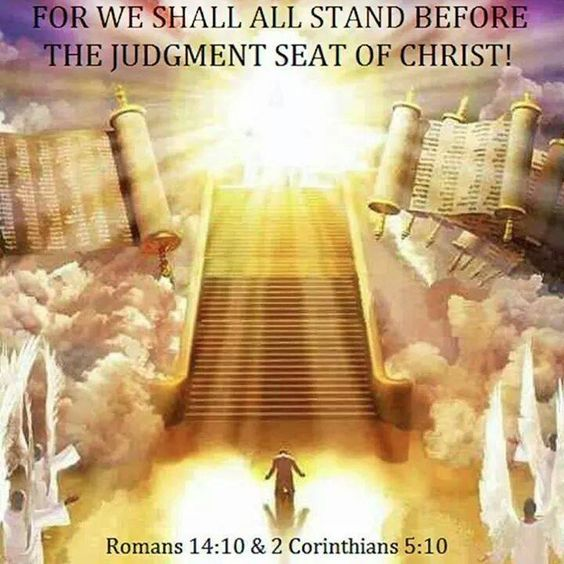
One day we will all stand before the Lord on judgment day to receive from Him the rewards for what we have done. II Cor. 5:10. 
I think I speak for all of us in that we fear we have not done enough or that what we have done is not good enough. 
I want to encourage you this morning.  

I remember an experience I had years and years ago!  
I was in 7th grade probably toward the end of the school year. 
One Sunday afternoon we had the house full of visitors.  Adults and kids, it was loud - our house was small. I was playing with the other kids when suddenly I remembered,  I had homework I had not done. An essay for English Literature - showing how  a certain theme  ran through one of the character's lives.  I panicked,  knowing that when the visitors finally went home it would be bedtime and Mom was very strict about bedtimes..  So, I got paper and pen and sat down at the kitchen table, distracted by the noise around me, but I got the essay written.  Relieved, I was happy that at least I had something to hand in the next day. 
On Tuesday morning we were waiting for class to begin when our teacher walked in, visibly very upset about something. 
Without any greeting he said, "I am going to read you one the essays that were handed in yesterday."
To my utter horror, as he started reading I realized it was my essay he was reading.  I was hot/cold, so embarrassed and desperately wishing my desk would sink into the floor!  
When  finally he finished reading it, he threw it on his desk and exclaimed, "Now, if ONE of you can write like that, WHAT IN THE WORLD IS THE MATTER WITH THE REST OF YOU !!"  
What? ???   He was PRAISING my essay?   

In remembering that experience I thought about how that will be the same for many of us on judgement day. 
We all  judge ourselves  according to the world's standards or expectations and compare ourselves one to another.  But I believe God judges differently. 
I let my mind drift  over the women in the Bible that are praised for something they did. 
Ruth - has a Bible book named for her - but she did nothing more than be loyal and kind in her relationships. 
Abigail - became the wife of King David -- she did nothing more than cover for a wicked husband.
Esther saved a nation -- but she did nothing other than honor and obey her cousin/uncle. 
The Shunamite woman  - whose heart desire was granted - did nothing other than be hospitable. (to Elijah) 
The widow of Zarephath - used by God to feed Elijah, as well as herself and her son  - did nothing more than be willing to feed a stranger passing by. 
Dorcas/Tabitha - raised from the dead -  did nothing more than sew clothes for widows she knew. 
Hanna -- was given her heart's desire - she did nothing more long to be a mother and was a good one. 
Mary, Martha - were hospitable - loved Jesus - and their brother was raised from the dead. 
Peter's mother - was a good cook - hospitable -- and was raised from the dead. 
The woman at the well -  all she did was share her experience - and a whole town was taught by Jesus. 
Lydia - did nothing more than gather with women to pray at the river.- she worshipped God and opened her heart to hear Paul's message, yet her name is recorded in our scriptures.

The above women all have a place of honor in the pages of our Bible but if you note , none of them did anything extraordinary.  They all just did what was in their heart and mind to do.  It wasn't something they thought about and purposefully planned out  because they thought it would please God!  
We are so performance oriented .... and believe that for something to be worthy of  praise from God it must be something difficult - something we would rather not do - something painful. 
As a parent,  is that what you wish for your children?  Do they please you only when they do something they don't want to do?  are not even suited to do?   Then why do we think that God- the perfect FAther - would expect us to do what is difficult for us to do?   Has He not created each of us, unique in our person, and placed exactly where we are suited to serve Him! 

When we one day stand before God on judgement day, trembling like I did on that school day before my teacher, we will be surprised at what God points out in our life that was praiseworthy. 
I don't think Billy Graham will be praised for his huge revival meetings, or altar calls.   It will be something much more personal, something that he didn't even realize was praiseworthy.  Something he did out of his heart because it didn't occur to him to do otherwise! 

So I encourage you today to go through your day doing what you desire to do because it gives you pleasure or fulfillment - and know that God expects or wants nothing more - or less !